
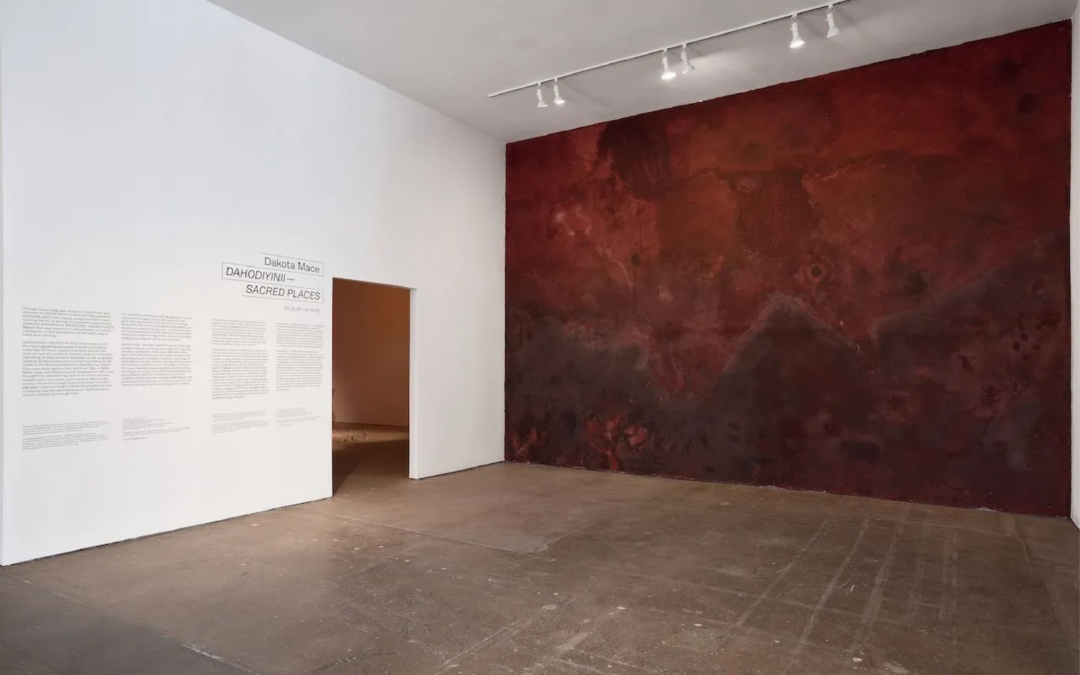
Dakota Mace’s 2025 art installation “DAHODIYINII—SACRED PLACES,” which was displayed at SITE Santa Fe in New Mexico, opens with a full-wall piece titled “Halchíí (Red Area)” that consists of dark red, deep orange, and dull brown hues. Abstract in nature, its colors and shapes—which utilize cochineal pigment and earth sourced from Arizona and Mexico—could resemble the humble slopes of hills, smears of clay dirt, or even stains of blood. One might also be inclined to see nothing—to leave its colors without meaning, to accept the absence of a clear shape as a signal of emptiness.
But this inclination to see nothing—especially when it comes to depictions of land—is exactly the intervention that Mace puts forth in her work, which spans both photography and textile arts. As a Diné artist who grew up in New Mexico, Mace is attuned to the stories, gifts, and pain that land holds, especially for Indigenous peoples.
Mace first moved to Madison to pursue MA and MFA degrees in Photography and Textile Design at the University of Wisconsin-Madison, and has been an integral part of the arts community ever since. Developing workshops around cultural appropriation and design sovereignty, Mace creates spaces for dialogue about people’s relationships with Indigenous art and pushes them to think critically about the ways in which land provides us with the very materials to make that art.
Now, as Textile Arts Center of Madison (TAC)’s first-ever artist-in-residence, Mace continues to give back to the Madison community by facilitating a group art project and developing workshops featuring artists from Teejop (the Ho-Chunk name for the place where Madison now sits), all while bringing pieces of home with her. Her current project, entitled “Land and Place,” invites TAC visitors to create photograms on silk organza as part of a larger memory quilt exploring the history of Teejop land and its importance to Indigenous people in Wisconsin. It is inspired by the matrilineal practices of Diné grandmothers, mothers, aunts, and sisters of passing down textile artistry to younger generations.
Mace will be TAC’s artist-in-residence until June, and she will be present at TAC on Thursdays from 12 p.m. to 4 p.m. to assist community members in contributing to the memory quilt.