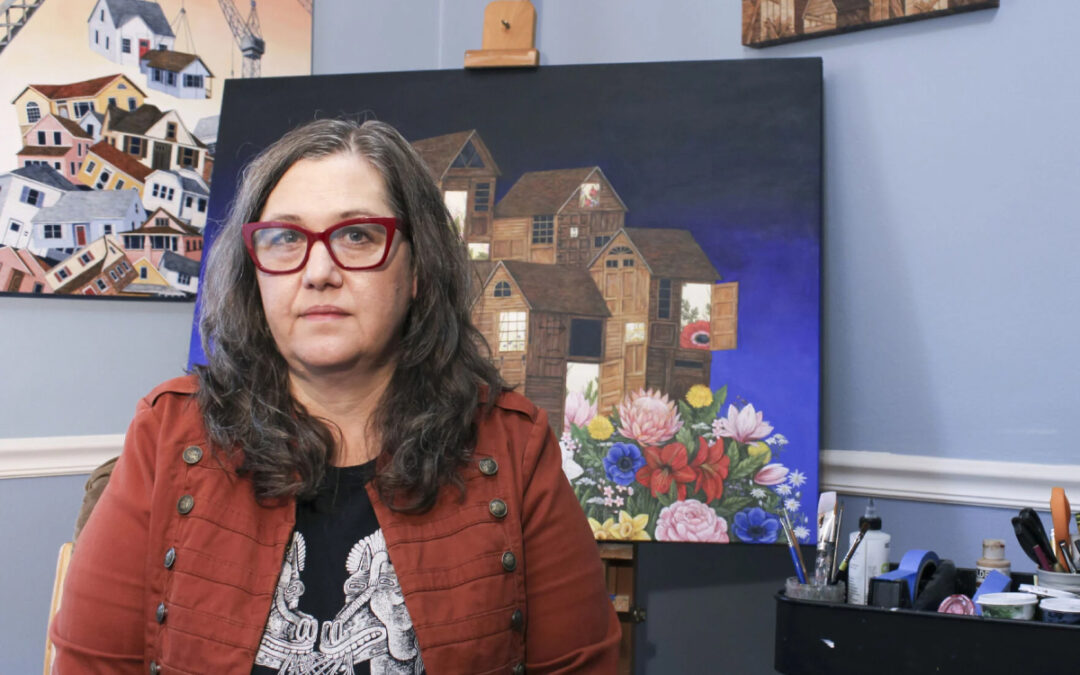
When Madison artist Sandra Schoen learned she’d been selected as a recipient of this year’s $10,000 Forward Art Prize, she was floored.
“It’s still just too much, I can’t believe it,” said Schoen. “I feel really grateful that my work was recognized as something that people wanted to see. That’s really recharging.”
Each year since 2019, the Forward Art Prize awards two local visual artists top prizes of $10,000, for unrestricted use. Eighty-one artists applied in this year’s cycle, up from 73 applicants in 2025. Schoen and fellow winner J. Myszka Lewis [MFA ’15] both expressed gratitude at being recognized for their art in a state where the visual arts are significantly underfunded.
“It’s so special that the prize is specific to this region, because the arts are not valued in Wisconsin,” said Lewis. “If you look at state funding, it’s one of the lowest of all 50 states. So the fact that Bird (Ross) and Brenda (Baker) did so much work to set up this fund to support women artists here is so important.”
Artists Bird Ross and Brenda Baker founded the Women Artists Forward Fund in 2017 to support women-identifying and nonbinary artists in Dane County, and acknowledge the persistent realities of gender inequity in the contemporary art world.
This year’s winners, Lewis and Schoen, were honored at a reception at Giant Jones Brewing Co., where their work will be on display alongside the work of other applicants as a part of the “Women’s Work” show through Nov. 28.
Sandra Schoen: Reflections on aging
Schoen studied at the School of the Art Institute of Chicago before earning her BFA from the University of Wisconsin-Madison. While she studied for a certificate in art education at UW-Madison, she juggled the demands of being a teacher, artist and mother all at once.
Her varying relationships with art from her early years of motherhood to now have played a key role in guiding the emotional dimensions of her art. Two of Schoen’s paintings on view during the “Women’s Work” show, “Morning House” and “Evening House,” use architectural forms to speak to recurring themes of growing up within her work.
“They’re meditations on age,” said Schoen. “One’s about being young and the other one’s about being in my midlife, and it’s about how the insides and the outsides are very different at those times in your life.