
Growing up in Marin, Douglas Rosenberg would often hop in his Volkswagen Bus and head to an art house in Berkeley, where he’d watch foreign films with friends or by himself.
“I saw a lot of films by Ingmar Bergman. And they stuck with me throughout the years, through lots of different projects,” said Rosenberg, a filmmaker and visual artist whose work has been shown around the world.
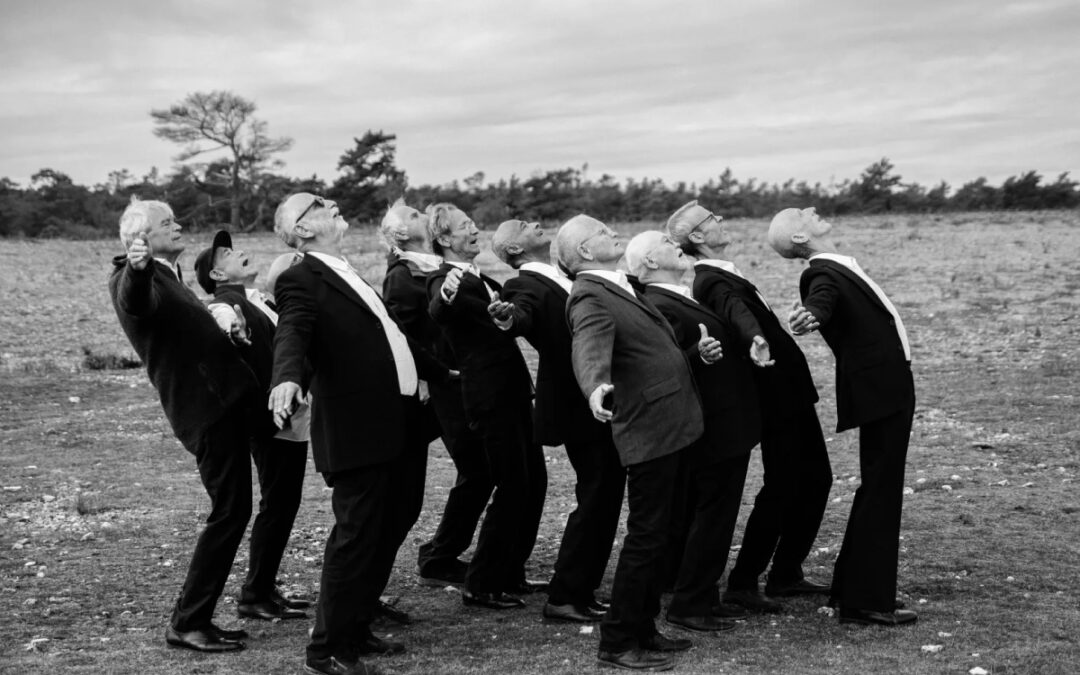
Decades later, to his delight, he would find himself in Fårö, an island in the Baltic Sea near Sweden where the late Bergman lived and shot some of his most iconic films, to shoot his own black-and-white film, “The Sea.” Featuring a cast of predominantly untrained male performers from the Fårö area, the film explores aging and the intimate relationships between men in their later years — a topic that’s personal to Rosenberg, who will turn 70 in December. The film “reflects on camaraderie and the ways life’s experiences leave their marks on our bodies, expressed through movement and the passage of time.”
The film will be shown at 11 a.m. Sunday at the San Francisco Dance Film Festival. Rosenberg will answer questions about the film after the showing at the Brava Theater Center in San Francisco. Admission is $16 to $40. Get tickets at sfdancefilmfest.org/fall-festival-2026/the-sea.
It’s a special homecoming for the Marin native who left the Bay Area after meeting and falling in love with his wife, choreographer Li Chiao-Ping, who got a job opportunity in Wisconsin, where they still reside.
Ahead of the screening, he took the time to reflect on the film and his time in Marin.
Q: How did you get into the arts?
A: I was born in 1956. My generation grew up in this incredibly creative and permissive time. In seventh grade at Red Hill in San Anselmo, I had an art teacher named Ted Allen. He gave us the opportunity to learn how to do all sorts of things with art, to be really creative and playful. He changed my life. The librarian at the time was his partner, Martha, who was a dancer from New York. The two of them just changed my world. I’m still in touch with them, and they have tickets for the screening.
At then-Drake High School, Archie Williams was my math teacher, and one of my classmates was Ed Neumeier, who wrote “RoboCop.” Williams came into class one day and said, “Hey, I’ve got these film cameras, if anybody wants to check these out and play with them, you’re welcome to.” Ed and I said that we wanted to. We went around campus, and made these little movies. Ed and I were both in a film festival together recently, and we talked about that story. Williams happened to be there along with all these other very eccentric teachers who opened the doors for us to do pretty much anything we could think of.
Q: “The Sea” started as a workshop. What made you want to explore this topic?
A: I often make projects that take a long time to gestate. I often start them with some kind of workshop with a group of people who might be interested in the thing that we’re attempting to do. We all spend time together and workshop these ideas and sometimes they grow into something else. But in this case, the hope was that we would be able to make a film from this workshop about masculinity, thinking about how men comport themselves as they get older, thinking about how so little really gets discussed in communities of men, all sorts of things.
When my father died around 30 years ago, I really started thinking about how his life was different from mine. There was a place in San Rafael my dad used to go to in the mornings for breakfast, and he would eat with this group of men. That would be their hangout. Maybe they would talk to each other; maybe they wouldn’t. Most of them had been in the war. In my mind, they had this kind of bond. I realized I didn’t really have that in my life. Sometime after that, after he died, I started thinking more about that and started making some smaller projects having to do with men, and always wanted to do a much bigger film project, which I finally did with “The Sea.”
Q: How did you approach the choreography with Benno Voorham and David Dorfman?
A: Starting from that workshop, the things that I brought to that group were very much about the things that I was remembering from my childhood, the way you’d play around with your male friends, and the way you’d lean on each other without any sense of shame. You’d throw yourself on your buddy, and you’d wrestle and all those kinds of things young kids, to a certain extent, take for granted before they get older. And remembering the games we used to play. A lot of what you see in that film is based on those things.
Q: How important was where the film was shot to the film?