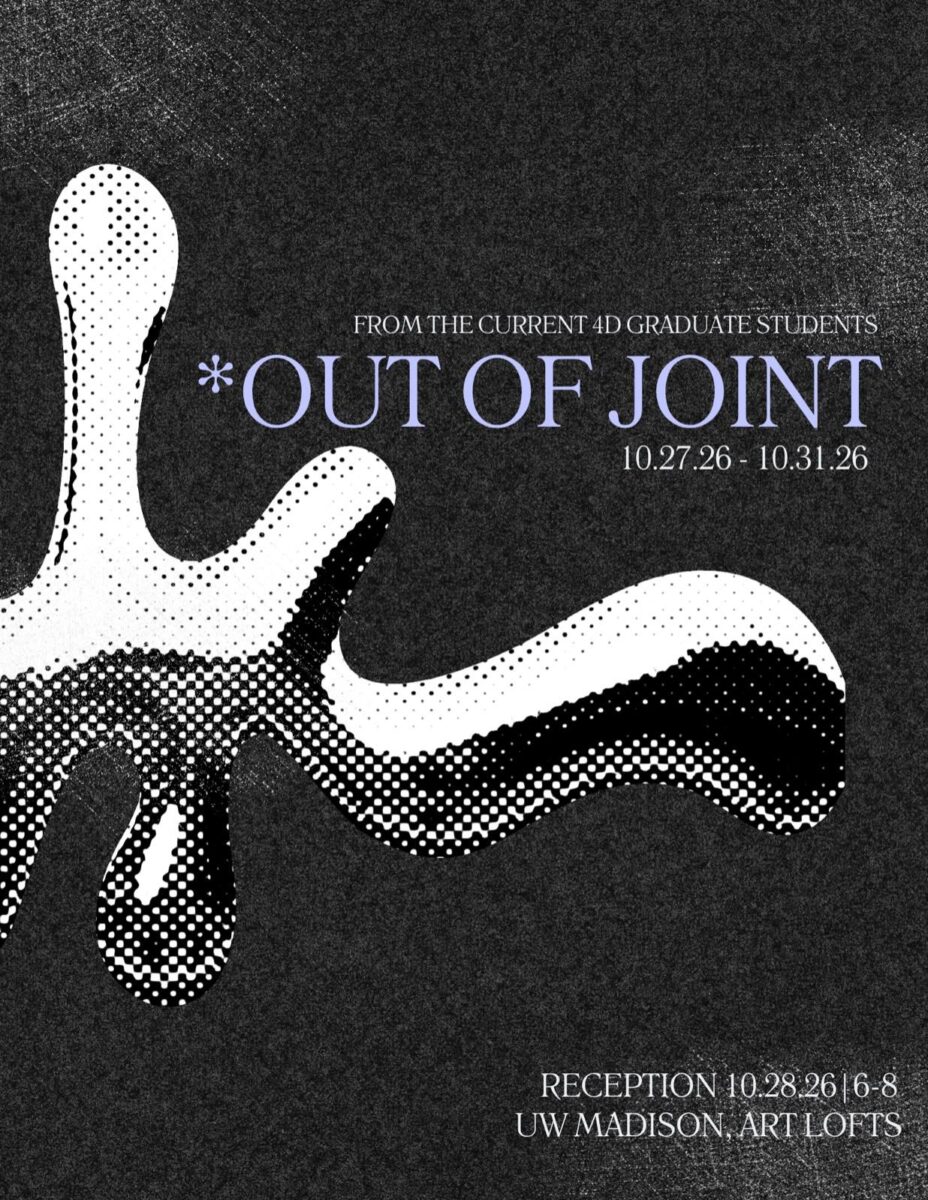
October 27 – 31
Artists: Anastasiia Bulatova, Brianna Cole, Claudia Krogmeier, and Cristina Rojas-Moises
Reception: Wednesday, October 28, 6-8pm, Performance at 7pm
Location: Backspace Gallery, Art Lofts, 111 N Frances St, Madison, WI
The Intermedia Arts 4D area explores the potential of research that may exist in the space between disciplines and medium specific practices to create a community of artists and scholars that collaborates in a spirit of exploration and discovery regardless of disciplinary boundaries. The research coalesces around ideas and concepts that are flexible, responsive, fluid and open which may include either singularly or in combination elements of the following: installation, “newer” genres, “newer” media, performance, physical computing, social practice, time based art, video art, video essay, collaborative practices, digital fabrication, generative art/code, hybrid and interdisciplinary approaches, digital media, 2D and 3D digital animation, and digital imaging.
Anastasiia Bulatova is a performance artist and researcher whose work investigates the body at the intersection of digital infrastructure, political power, and spatial control. Working across live performance, video, and installation, their practice examines how bodies are rendered, mediated, and disciplined by both physical architecture and algorithmic systems. Drawing on Michel Foucault’s disciplinary power, Gilles Deleuze’s societies of control, they look into how different systems organize, represent, and mediate bodily experience, equally interested in the possibilities that emerge within these systems as glitches, distortions, fragmented identities, and forms of embodiment that resist the logic of those systems. In their ongoing project, Cartographic Struggle of Performing Corporeality in Digital Terrain, they examine the relationship between the body, architecture, and digital mapping technologies, such as during a recent research trip to Belgrade, Serbia, where they performed and documented their performances using 360° photography and Google Street View as both artistic media and infrastructures of spatial control. Their work approaches the body not just as an object subjected to technological and political systems, but as a site where new forms of social relations, political possibilities, and self-perception can emerge.
Brianna Cole’s artistic practice is rooted in world-building and storytelling, a continuous search for the elusive element of herself that finds expression through making, sharing, and imagining. Navigating the chaos and beauty of creation with curiosity and embracing the unknown and allowing failure to guide discovery, each project is an invitation to explore personal and collective experiences, to inhabit spaces both whimsical and uncanny, and to uncover the hidden patterns of human longing and imagination. From installations to prints, drawings, collage, and 3D environments, she experiments across mediums to translate emotional and conceptual ideas into tangible forms. In her role as a Wish Room Ambassador, Cole explores hope as a shared practice, creating participatory spaces where participants’ desires, reflections, and dreams converge into ritual, sound, and archive. These acts of engagement transform private longing into collective resonance, bridging individual experience with broader emotional networks.
Claudia Krogmeier is a digital media artist whose practice spans experimental and narrative film, installation, interactive digital media, scientific research, and extended reality to explore emotional intensity, illusions of understanding, and the subconscious mind. She is intrigued by story cycles in which logic falls away, creating new space for excitement in the bizarre, the uncanny and the intuitive, exploring dream-like realities that can arise in our minds in relation to our desires and life experiences by creating work that feels emotionally truthful. She challenges dominant forms of narrative which are linear and transparent to invite viewers to draw their own conclusions about the meaning of the work.
Cristina Rojas-Moises’s practice investigates the malleability of language and representation, specifically as a response to institutional authority and dominant social narratives. By deconstructing the sources and effects of authority on both bureaucratic and experiential levels, she considers the processes through which power is exerted as well as the body as a site where it can be sensed and embodied. Using the visual language of multiplicity, seriality, and fragmentation to engage viewers with the contradictions and breakages in reality that come about from the manipulation of culture and the fragility of a shared social language, she highlights the elusive and fluid character of power, encouraging them to look up, down, to the side, moving their focus across various focal points. Through this exploration, her work found a home in photography and film, mediums that transform the audience’s relationship to representation, evidence, and authenticity. By challenging the mimetic abilities of the camera, she encourages audiences to consider the materiality of the image and question its legibility. Breaking polaroids, introducing foreign materials to the enlarger, using thread to create compositions, she emphasizes the image as an object that embraces spillage, contradiction, and confusion as a productive tool for looking and examining spaces where power is exerted, from tech monopolies to institutions in Western academia.