
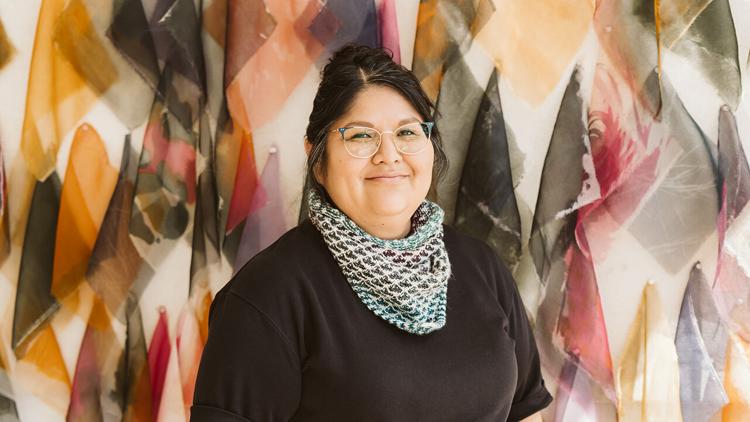
The Diné artist (and the inaugural artist-in-residence at the Textile Arts Center of Madison) fuses photography, weaving, beadwork and papermaking.
On a cluttered table in Dakota Mace’s [MFA ’19] studio, bowls of shells and beads lie atop scraps of photo paper and dyed fabric. Mace, a Diné (Navajo) artist and the inaugural artist-in-residence at the Textile Arts Center of Madison, or TAC, specializes in textiles and photography — but instead of using a camera, she captures images using techniques like cyanotype and chemigrams.
“Have you ever seen the imprint of a leaf on a sidewalk? That’s a photograph,” she says. “It’s the plant matter itself creating what we [define as] a photograph.”
During her residency, Mace is exploring SolarFast dyeing, a process in which the artist applies a UV-sensitive dye to fabric, places an object on top and exposes it to sunlight to create an image.
Mace often carries expired photo paper or pre-coated cyanotype paper with her, ready to capture inspiration from the places around her. Indigenous sites with historic significance are a major touchstone in her work. For one project, she extracted soil from the ground at Hwéeldi (the Diné name for Fort Sumner in New Mexico, where many Diné people were imprisoned from 1864 to 1868), mixed it into a developing bath and fixed images directly on top of it.
Once the photographs are developed, Mace builds on the images — often abstract depictions of landscapes — using raw materials like wool from Navajo-Churro sheep or by adding buttons, beads or shells.
Mace’s residency at TAC includes a drop-in community art project. Titled “Shímásání Bila’ (My Grandmother’s Hand),” the project runs through June 30 and allows participants to experiment with the SolarFast process using personal objects.