
Artist uses public records and data-driven audio to reinterpret protest footage and surveillance systems
A University of Wisconsin–Madison graduate student has turned municipal surveillance footage of protests into a multi-channel installation examining policing, disability and public space in the United States.
The exhibit, titled “Infrastructure Bodies/Injury Systems: An Exhibition by Anne E. Stoner,” is on view beginning April 10 at the university’s Memorial Union.
The project, which earned Anne E. Stoner the 2026 Russell and Paula Panczenko MFA Prize, combines video captured from public surveillance systems with sound generated from both data and human voices. The MFA Prize is offered annually by the Chazen Museum of Art in collaboration with the UW–Madison art department.
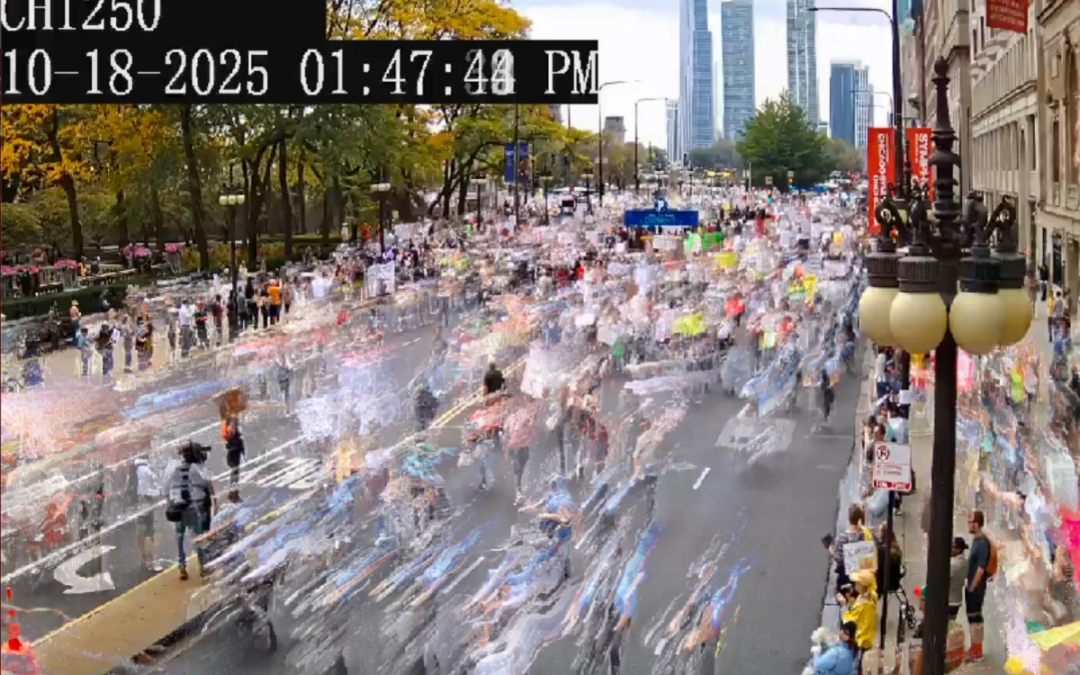
The result is an immersive environment that draws on footage of protests and law enforcement activity in Midwestern cities, translating movement into sound while foregrounding the bodily consequences of those events.
Stoner said there are two main ways in which the audio sounds. One of them is very data-driven in which she tracks changes in pixels in surveillance footage and maps that movement to sound. That audio is layered with what is effectively a software instrument—a digital synthesizer—she created using recorded hums of people injured in protests.
“I’m a big coder, so I built a system that breaks down the pixel movement of the CCTV videos,” she said. “It’s a very binary system, it’s very much like, ‘Is this pixel changing color, which signifies movement?’ If yes, it adds to the number of pixels moving.”
She said that audio will sound like a computer game, but with its tones randomized by how people are moving. Neither of the audio types will sound like tonal music, by design. Still, she hopes that the two distinct and opposite qualities of sound, one which is very digital and one which is very human-driven, will offset one another.