
Stewards of the land, the Ho-Chunk had been living on the shores of Lakes Mendota and Monona for thousands of years. But in 1832, the HoChunk signed a treaty with the United States that forced them from their land and unleashed an onslaught of ethnic cleansing for decades to come. Despite the violence, the Ho-Chunk either refused to leave or returned eagerly. The treaty granted settlers access to their once sacred Four Lakes region, and UW–Madison was erected in 1848. Later becoming a land grant university, the University further ceded some 240,000 acres of land from the Ho-Chunk after Congress passed legislation in 1862 to establish a network of universities around the country dedicated to agriculture and mechanics—thus the College of Agriculture and Life Sciences was born.
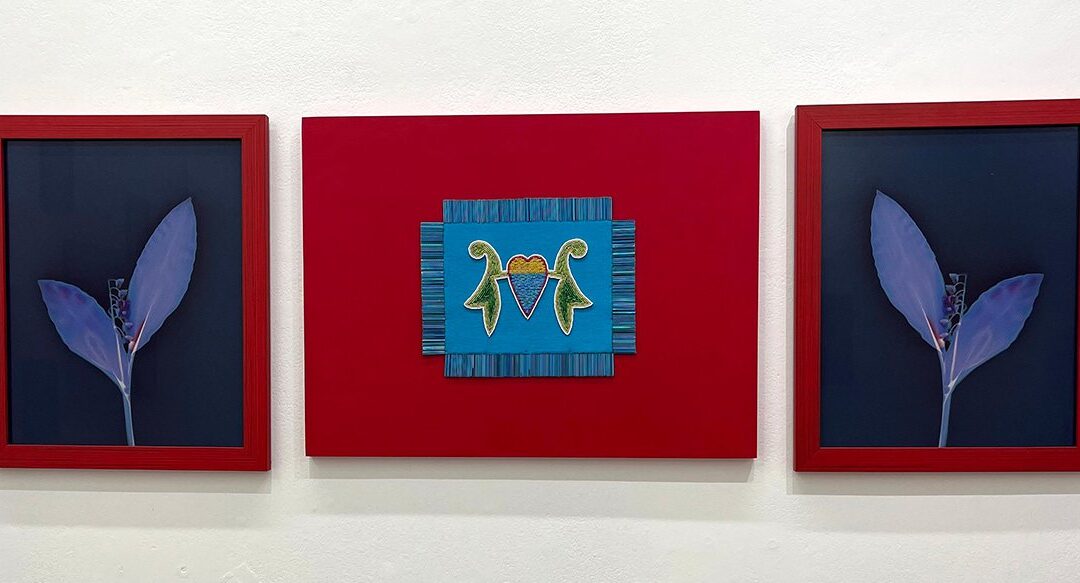
But it was UW-Madison’s art department that began reckoning with this sinister colonial history, championing Indigenous art, education and mentorship starting in the 1950s. Now showing at Portrait Society Gallery on the fifth floor of the Marshall Building, “Four Directions, One Community” is a multigenerational show of Madison faculty and students exhibiting an array of traditional motifs with contemporary touches that speak to the indigenous experience across time and space.
Gibson Byrd was the first Native faculty member in the art department, the spearhead of further Indigenous involvement. When Byrd began at the university, it was 1955, the aftermath of ethnic cleansing still stung, and Indigeneity was not in vogue. To be hidden, not to be prideful of. His Man Eating Hamburger (1956) pictures a terra cotta skinned man biting out of a simply rendered yet quintessentially American symbol, the hamburger. The man looks the viewer straight in the eye, almost like we caught him in the act. The piece speaks to assimilation, almost shame, yet acceptance.
There is an eerie sense to the piece, no blue sky to color the background, a yellow greyness that creeps the haunting of colonial impact into the scene. Yet his adjacent piece, The Presence (1990), brings a gentleness to a uniquely Midwestern landscape. The bluffs of a kettle sit in the distance of an open field under puffy white clouds in the baby blue sky. It’s a lens of beauty and respect on these glacial lands that imbues this piece with a serenity Indignity holds in homeland.
Organic Wood Sculpture
The show flows into Truman Lowe (Ho-Chunk), a sculpture artist working in delicate organic wood pieces that render hard materials into gentle delicate works of balance and harmony. Rejected from UW–Milwaukee, Lowe went on to graduate from UW–Madison, eventually getting a master’s degree and becoming a professor in the art department thanks to Byrd’s recruitment. Together the two stewarded further Indigenous recruitment for both faculty and students. Mimicking the natural world in which they are derived, Lowe’s pieces sit in staunch presence with a delicate grace, like Native people on these lands for time immemorial.