
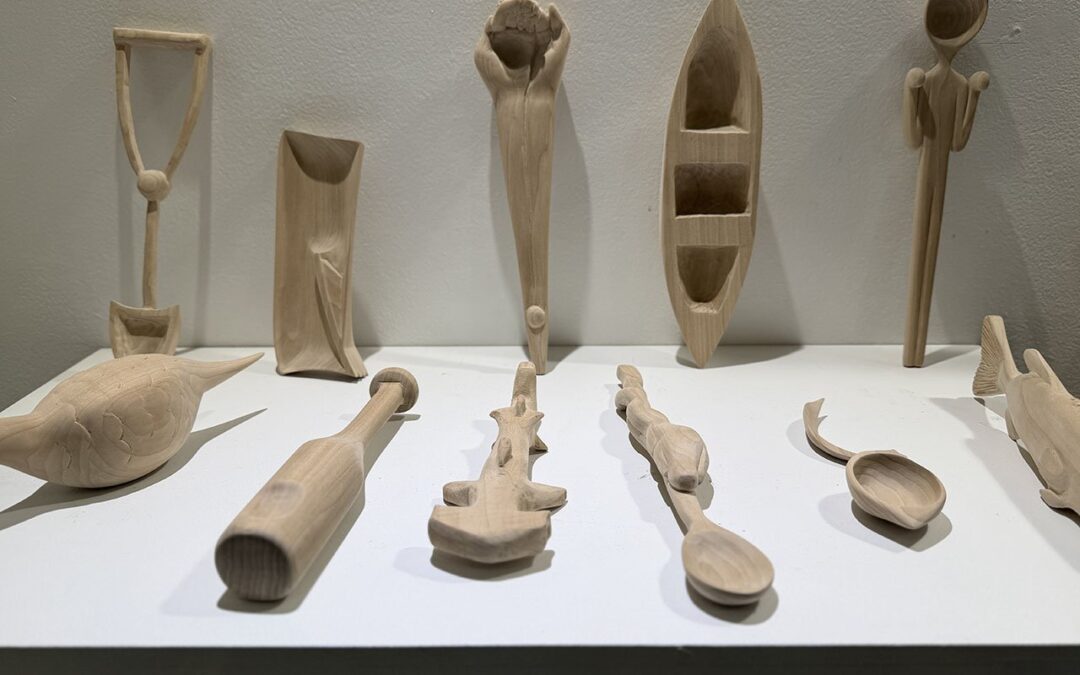
A fish with ornate tail fins and sunken round eyes. A bird with a long swooping neck with a ladle for a head. Arms outstretched into oversized cupped hands. A statuette with a concave face. A canoe.
These are examples of the “spoons” created by the fall semester students of UW-Madison’s Art 334 Wood Working course. Their very first assignment is hand carving the utensil out of a block of poplar. But there is a reason that Katie Hudnall — the director of UW’s woodworking and furniture program — calls it the “not a spoon” assignment.
“If the project was just shaping a perfect wooden spoon, they wouldn’t really get the chance to design something for themselves,” says Hudnall. “The assignment is really to create not just a spoon. The design element is what gets them to unlock their art brains.”
And that is one of the broader goals of the class and UW-Madison’s woodworking and furniture program, which has been part of the art school for decades. Hudnall became the director of the program in 2020. She teaches graduate students studying sculpture and artisan furniture makers. Many of her undergraduates are also seeking art degrees. But Hudnall has been proactive about encouraging non-art majors to take woodworking. She’s had students majoring in theater, biochemistry and engineering. One of her recent students was studying to become a dentist.
“When I started, there was no demand for the class beyond the art department,” says Hudnall. “The semester after COVID, I just started putting posters up all over campus. And the response from students has been huge. We now have a wait list.”
Traditionally, introductory woodworking classes start with carving a spoon — that, or a mallet.
“I tell students it has to have that convex, back-of-the spoon shape and it has to have a handle-like form,” says Hudnall. “The twist is it’s gotta be beyond just your grandma’s kitchen spoon.”
That results in the spoons taking on a variety of shapes, sizes, and forms both literal and abstract. In general, the finished pieces usually resemble something one could use to sip soup. Others are a stretch — depending on how deep you want to dive into defining the fundamental characteristics of a “spoon.”
Hudnall explains the assignment helps students get a feel for the tools they’ll be using later in the semester. It’s also their first foray into understanding the unique medium that is wood.
“When you first start to carve wood, you suddenly understand that it has a grain direction. If you carve the wrong way, you’ll get what’s called tear-out, which is when the wood fibers are torn rather than cleanly cut,” says Hudnall. In addition, “the ingrain is much denser than the side grains or long grains. So in this assignment you’re learning all that, at human speed. It’s slow. It’s quiet.”
Ultimately, students move on to create community benches as a group and then they design their own tables. New skills — like milling and joinery — are learned along the way.
When Hudnall began teaching woodworking 20 years ago, most of her students had a family member who dabbled in woodworking as a hobby. She says many young people have lost that connection to creating something with their hands.