
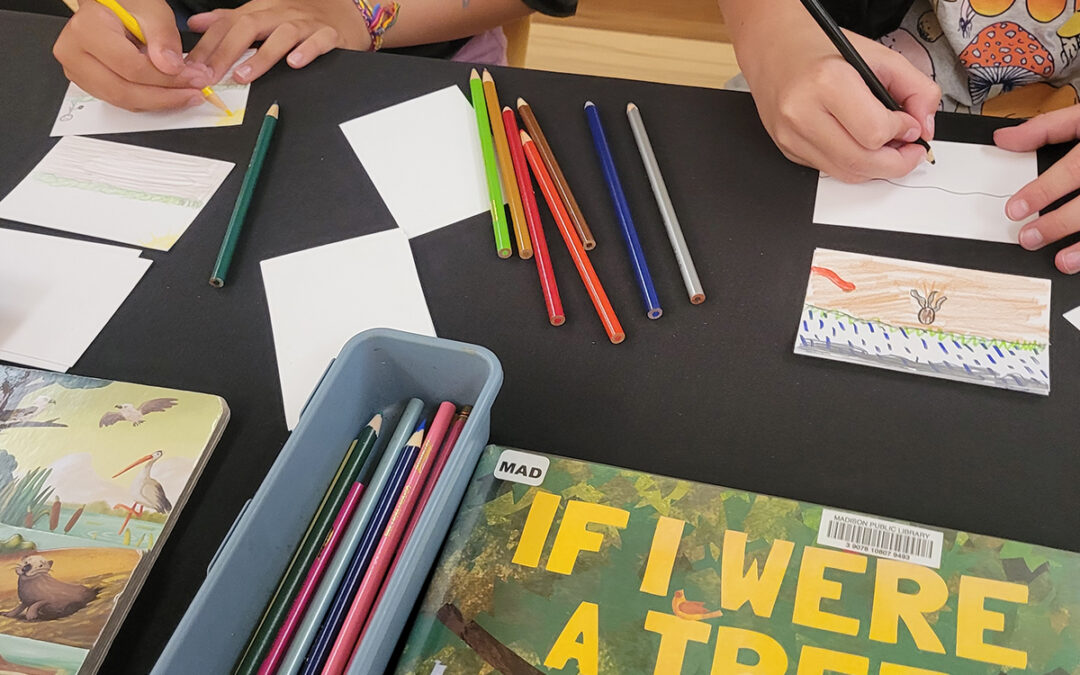
“How does your garden grow?” It’s a question posed often enough that it even appears in a classic nursery rhyme. When Angela Johnson [MFA ’16], a local artist and teaching faculty member in the UW Art Department, was asked to create a hands-on experience for kids to answer that question, she turned to another childhood favorite: flip books.
To get the books flipping, Johnson teamed up with genetics professor Patrick Masson. Masson studies molecular mechanisms that allow roots to respond to parameters in their environment, such as gravity and touch. He was recently awarded a grant from the National Science Foundation for a research project centered on root growth, and it included funding for outreach. So Masson and Johnson, who has worked on art and science fusion projects since 2006 and studied as a bookmaker, came up with the idea to help kids create flip books to illustrate the root growth concept.
“We wanted a hands-on experience that could help kids understand what ingredients are needed for roots to grow,” Johnson says. “I wanted it to be something they could hold and make themselves so they could see the progress of the root growth on every page.”
After some early trials and retooling, the team landed on a simple instruction sheet inside a kit that includes all the necessary supplies to create the flip book. Each participating child would choose a plant and then follow their instruction sheet to draw their plant growing at different stages. First, they would think about questions posted on the sheet (e.g., “How do roots know where to go?”).
Next, with their drawings of the different stages of growth complete, the budding artists assembled their books and “animated” them by rapidly flipping the pages.
Volunteers from the Pinney Branch of the Madison Public Library produced, packed, and distributed more than 500 kits to botanical gardens, libraries, museums, and other locations throughout Wisconsin in 2024 and early 2025. At many locations, families had the option to grab a kit to take home or to sit down at a hosted event to create their flip book. Some kids arrived with specific ideas, while others looked through materials to find their chosen root.
“One boy wanted to draw a carrot that would get eaten by a rabbit,” Johnson says. “We wanted to leave it open-ended so families and kids could choose their own plant and their growing conditions. We worked with youth librarians to find books and reading suggestions to go with the activity.”