
The Wisconsin Triennial, at the Madison Museum of Contemporary Art through Sept. 14, is more than a showcase of 24 working artists from around the state. This exhibition challenges visitors to connect with modern art in new ways, question ideas about museums, and wake up their senses to what is happening in Wisconsin today.
For this year’s Triennial, the in-house curators were looking for artists whose work reflects our current moment while acknowledging what has changed, or hasn’t changed, since 2022.
The museum’s three-story wedge of glass may be a landmark on State Street, but not everyone feels drawn to walk through the museum’s doors. Museum director Paul Baker Prindle has acknowledged that it’s hard to get people away from their screens to interact with art in person. To that end, the 2025 Triennial was designed with multiple entry points to elicit reactions and welcome people into the conversation.
The explanatory labels for each artwork are in large print and in Spanish as well as English. And the label texts were written by the artists themselves instead of by a curator, which makes them feel like conversation starters. There is also a Triennial Talk podcast playlist on Spotify that can be opened in the gallery using a QR code or listened to anywhere. These short one- to four-minute audio pieces are reflections on specific artworks by local celebrities, politicians, art historians and other Wisconsinites.
A scavenger hunt geared toward young people enticed my own kids to explore the art. Piles of pillow-like furniture in the gallery set a playful mood and before long, the teens were lounging in the corner space surrounded by four large, colorful paintings by Madison-based artist Taj Matumbi. Matumbi’s bold graphics show layered influences in an accessible vernacular and seemed to put the younger visitors at ease.
Near the museum’s street-level welcome desk are three paintings by Madison artist Angélica Contreras. Her mixed media works invite viewers literally to lean in — to get closer. The layers of colors and textures are like hidden pictures filled with recognizable Latin American scenes and themes. For example, a piece called Globos (Balloons) is a vignette of an anonymous balloon vendor. The person is completely engulfed by their wares and only their legs are visible. With closer inspection the balloons reveal a composition of characters, brands, objects, and archetypes, all set against a brightly patterned background. In her label text, Contreras explains that her style echoes “the tradition of magical realism that has long been a cornerstone of Latin American literature and art.”
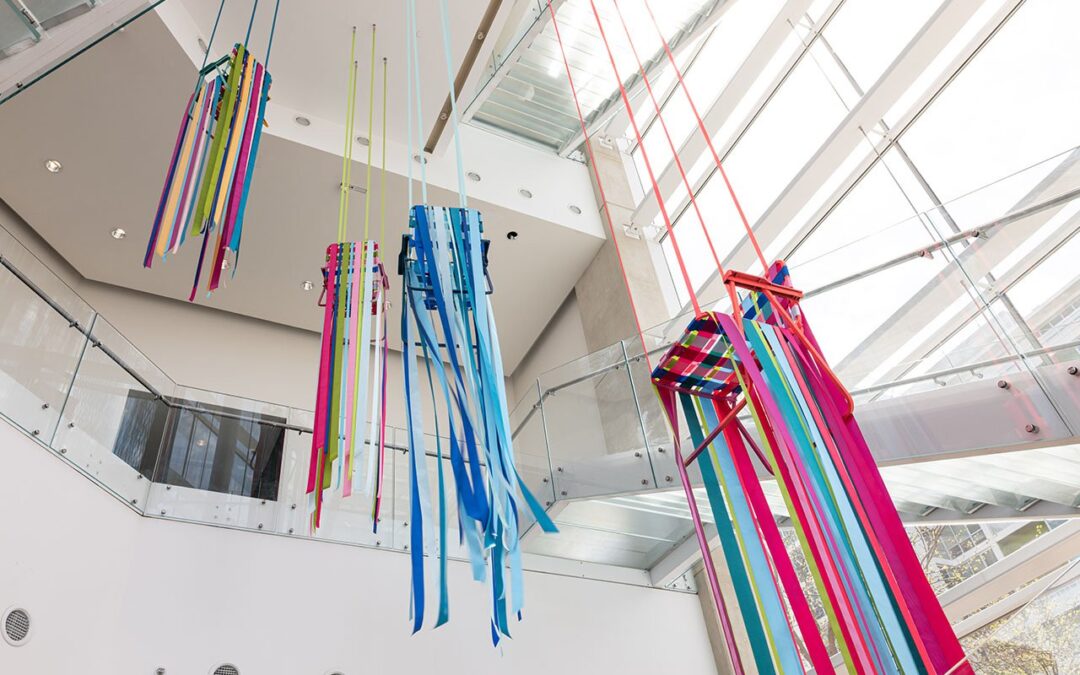
Over the glass stairwell leading up to the full show on the second floor is a rainbow of ribbons called Ceremonial (Pow Wow Ribbon Chair). On the label, the artist John Hitchcock explains that chairs are common objects that provide support, comfort and inclusion. Hitchcock, a professor of art at UW-Madison, is an enrolled member of the Kiowa Tribe of Oklahoma and of Comanche and Northern European descent. The colorful ribbons are beautiful in the sunlit atrium and are visible from the street — hopefully drawing people inside. Ceremonial also feels like an acknowledgement that we are on Native land.
Indigenous presence in the 2025 Triennial is powerful. Four artists — Hitchcock, Tom Antell, Jolene Frechette and Tom Jones — are Native American.